




 Whitman Expo



The unprecedented crossover underscores his personal efforts to combat “grade inflation.”
Thank you to our sponsors!
Go check them out!




Obverse Description
A shield flanked on the left and right by leaves topped with a cross with arrows positioned behind at the bottom so the arrow heads and shanks protrude at the sides. The motto IN GOD WE TRUST appears at the top periphery with the date positioned at the bottom center.
Reverse Description
A large numeral 5 surrounded by 13 stars centered in the design with UNITED STATES OF AMERICA * CENTS around the periphery.
Book Reference
Key to Collecting: This issue has the highest circulation-strike mintage of any Shield nickel (see mintage-estimate notes under the preceding listing). As the first year of the Without Rays design, this coin is in additional demand for inclusion in type sets. These were produced starting in February, the removal of the rays being considered a solution to help reduce the tremendous problems in striking that had taken place the previous year. It was hoped that the life of a pair of dies would exceed 10,000 coins on a regular basis. Indeed, the revision did help, and coins of the new type are generally better struck.
Examples of the 1867 Without Rays nickel are plentiful today in just about any grade desired. Among Mint State coins, most are in the lower ranges, up to MS-64. True gems are rare. Striking is a problem, despite the absence of the rays. Also, the majority of coins are light in one place or another, although generally better detailed than the coins of 1866. Still, if you seek a combination of sharp details, good luster, and good eye appeal, probably not more than 1 in 10 coins will qualify. However, you have an insider’s advantage in knowing what to look for—as most buyers are unaware, and certified holders make no mention of anything beyond a number.
Proofs are fairly elusive, and quality can be a problem, more in the way of eye appeal than in sharp details. Proofs exist from two reverse dies, style C (known as the normal reverse) and D (the Pattern Reverse; see pp. 39 and 40 for a detailed discussion). A normal-reverse Proof from the collection of 19th-century Baltimore numismatist T. Harrison Garrett, later in the Sunnywood Collection, is shown above.
CIRCULATION STRIKES:
Characteristics and Appearance: Most are lightly detailed in one area or another, and many, if not most, show die cracks. The latter is not a negative as far as price goes, but it is a feature that adds interest.
PROOF STRIKES:
Characteristics and Appearance: Usually seen with deeply mirrored fields, with contrasting devices, and, for coins that have not been overly cleaned, with good eye appeal. Some have lightness at the star centers.
Mintage and Distribution Notes: 750 to 1,100 (estimated). The earliest, and today the rarest, Proofs have the Pattern Reverse (stars point under the upright of E in STATES and at the center of A in AMERICA). These were probably included in the first delivery of 25 full Proof sets of the 1867 year on February 5, although others could have been delivered singly (and no record kept). The obverse die state is very early and slightly different from that seen on the normal Proofs with the normal reverse (stars point under right serif of E in STATES and between A and M in AMERICA).4 On the Sunnywood/Garrett Pattern Reverse coin, the obverse has a raised graver’s line, somewhat resembling a die crack, in the frame of the shield to the left of the horizontal stripes. The base of the 7 in 1867 shows traces of an earlier 7 in the field slightly to the left. On June 5, 1867, the Philadelphia Mint paid photographer M.P. Simons to take pictures of the “reverse of five cents,” type of coin not known (regular issue or pattern?).
Proof of 1867 with the Pattern Reverse.Proof of 1867 with the normal reverse.
VARIETIES:
Missing Leaf—No outside leaf on the second group at right; three leaves instead of four. Edward L. Fletcher describes seven dies with this feature, to which Howard Spindel has added two more.
Repunched Date—Several interesting repunched dates beckon, representing dies in which the four-digit logotype was first entered, then entered again in a slightly different position. FS-1102, F-54 has the date repunched to the south southwest and is also a doubled-die obverse (most noticeable at the annulet).
Catalog Information
GSID:
2895
Designer:
James B. Longacre
Obverse Designer:
James B. Longacre
Obverse Lettering:
IN GOD WE TRUST, 1867
Reverse Designer:
James B. Longacre
Reverse Lettering:
5, UNITED STATES OF AMERICA, CENTS
Weight (gr):
5 gr
Weight (oz):
0.1608 oz
Strike Type:
Proof
Diameter:
20.5
Coin Shape:
Round
Edge:
Plain
Variety:
No Rays
Coin Date:
1867
Denomination:
5c
Designation:
PR
Mint Location:
Philadelphia
Mintage:
600
Coinage Type:
Shield nickel
Coinage Years:
1867-1883
Composition:
75% copper; 25% nickel
PCGS #:
93821
Send Catalog Feedback
To: editor@greysheet.com
Subject: I would like to contribute catalog info to CDN for 1867 5c No Rays PR DCAM
Body: Referring page: http://dev.greysheet.com/prices/item/1867-five-cents-proof-deep-cameo-no-rays-shield-nickel/gsid/2895 GSID: 2895 Title: 1867 5c No Rays PR DCAM
Subscribe to View
View more data, info, and visualizations. Get access to retail and wholesale pricing as well as auction data.
Coin Value History
1867 5c No Rays PR DCAM
Value By Grade
1867 5c No Rays PR DCAM
CPG (retail) values
Currency
Grade Range
Grading Authority
Sort by
Pricing
Values
Greysheet & CPG® Values
Shield Nickel 5c Rays, 1866-1867 PR [Type]
![Shield Nickel 5c Rays, 1866-1867 PR [Type]](https://images.greysheet.com/Ctc/CatalogEntry/ha_com_1316_3020-2.20200624040933286.jpg?MaxWidth=200&Mode=Pad&Scale=UpscaleCanvas&format=webp)
Worth: $875 – $12,600
1866 5c Rays PR

Worth: $875 – $12,600
1867 5c Rays PR

Worth: $18,000 – $50,000
Shield Nickel 5c No Rays, 1867-1883 PR [Type]
![Shield Nickel 5c No Rays, 1867-1883 PR [Type]](https://images.greysheet.com/Ctc/Catalog/ha_com_1291_4375-0.20200718080538892.jpg?MaxWidth=200&Mode=Pad&Scale=UpscaleCanvas&format=webp)
Worth: $180 – $6,600
1867 5c No Rays PR

Worth: $180 – $1,800
1867 5c No Rays, Pattern Reverse, FS-1902 PR

Worth: $1,800 – $13,200
1868 5c PR

Worth: $180 – $3,500
1869 5c PR

Worth: $180 – $3,960
1870 5c PR

Worth: $180 – $1,080
1871 5c PR

Worth: $180 – $5,400
1872 5c PR

Worth: $180 – $3,600
1873 5c Closed 3 PR

Worth: $180 – $2,880
1874 5c PR

Worth: $180 – $3,120
1875 5c PR

Worth: $180 – $6,000
1876 5c PR

Worth: $180 – $2,640
1867 5C No Rays PR64 Deep Cameo PCGS. PCGS Population: (2/5 and 0/1+). NGC Census: (0/4 and 0/0+). PR64. ...

$3,120
5C 1867 NO RAYS PCGS PR65 DCAM CAC

$8,812
1867 5C No Rays PR66+ Deep Cameo PCGS. CAC. ...

$22,800
1867 5C No Rays PR67 Ultra Cameo NGC. CAC. ...

$15,600
1867 5C No Rays PR64 Deep Cameo PCGS....

$1,920
5C 1867 NO RAYS. PCGS PR65 DCAM CAC

$10,575
1867 5C No Rays PR66 Ultra Cameo NGC. ...

$8,400
1867 5C No Rays PR67 Ultra Cameo NGC. ...

$9,900
1867 5C No Rays PR64 Deep Cameo PCGS. ...

$1,092
1867 5C No Rays PR65+ Deep Cameo PCGS. CAC. ...

$12,925
5C 1867 NO RAYS. PCGS PR66 DCAM CAC

$20,562
1867 5C No Rays PR67 Ultra Cameo NGC. ...

$9,988
1867 5C No Rays PR65 Deep Cameo PCGS. CAC. ...

$7,050
1867 5C No Rays PR66+ Deep Cameo PCGS. CAC. ...

$16,450
1867 5C No Rays PR67 Ultra Cameo NGC. ...

$12,650
1867 5C No Rays PR66 Ultra Cameo NGC. ...

$14,100
$14,950
1867 5C No Rays PR66 Deep Cameo PCGS. ...

$29,375
1867 5C No Rays PR66 Deep Cameo PCGS. CAC. ...

$35,250
Greysheet News
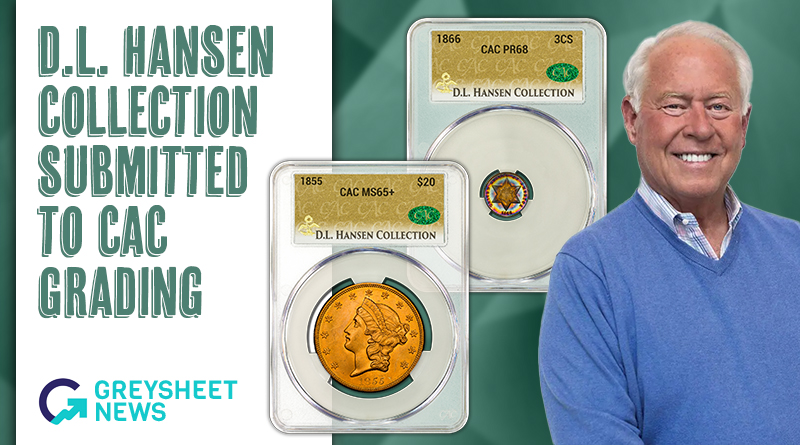
Prominent Collector Dell Loy Hansen Submitting His Historical Collection Of U.S. Coins To CAC Grading
8/8/2024
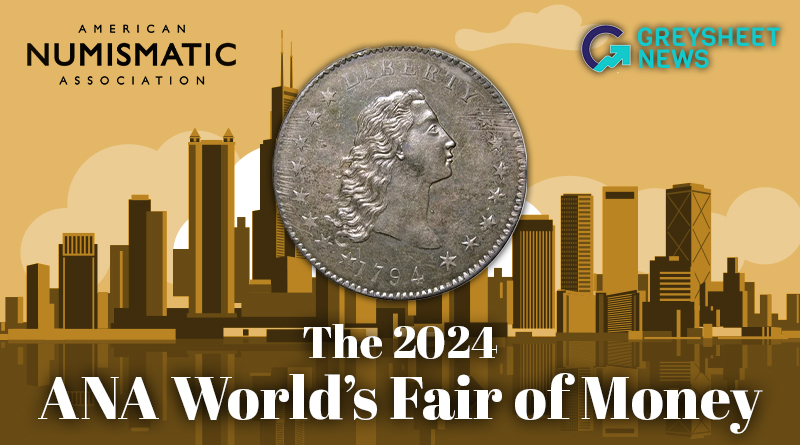
American Numismatic Association's Largest Coin Show, August 6-10 In Chicago
Dazzling rarities, free educational opportunities, family fun and more await at the Donald E. Stephens Convention Center
7/25/2024
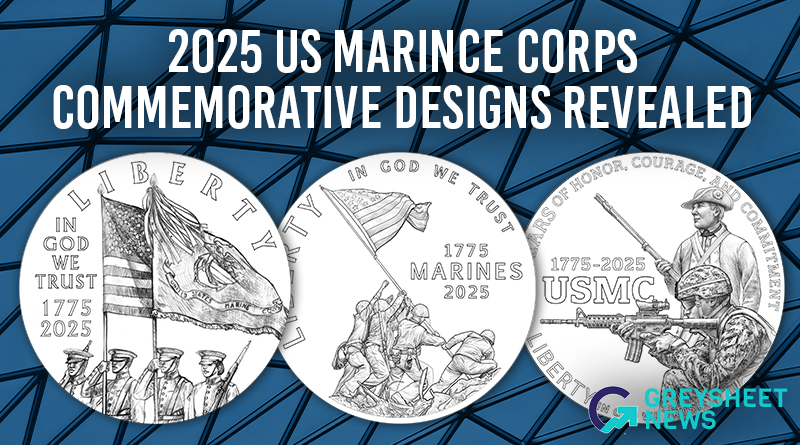
United States Mint Unveils Designs For The 2025 United States Marine Corps 250th Anniversary Commemorative Coin Program
The designs will be featured on a $5 gold coin, a $1 silver coin, and a half dollar clad coin.
7/23/2024
Events
Heritage Auctions: US Currency Tuesday Select Auction
Location: Heritage Auctions
Tuesday, June 2, 2026
Heritage Auctions: World Paper Money Tuesday Select Auction
Location: Heritage Auctions
Tuesday, June 2, 2026
Heritage Auctions: US Coins Tuesday & Wednesday Select Auction
Location: Heritage Auctions
Wednesday, June 3, 2026