




 Whitman Expo



The unprecedented crossover underscores his personal efforts to combat “grade inflation.”
Thank you to our sponsors!
Go check them out!





Very popular as the key date in the Flying Eagle business strike set, proof coins are far more common than their accepted business-strike counterparts (see 1856 Flying Eagle MS). For this reason, proof examples -- which are the most common date of any in the Flying Eagle type -- are more desirable than the 1857-1858 issues. Technically a pattern issue, also cataloged as Judd-180 (J-180).
Obverse Description
An eagle with wings extended in full flight fills the central obverse design with the words UNITED STATES OF AMERICA around the top periphery. The date is centered at the bottom.
Reverse Description
The reverse bears the denomination of ONE CENT in the center surrounded by a wreath bearing a ribbon tied in at the bottom center.
Book Reference
1856 Cent Production: The 1856 Flying Eagle cent was first produced in late 1856 and early 1857 as a pattern coin, to persuade Congress to drastically change the cent coinage from the large copper pieces then in circulation to a small copper-nickel coin. As this was the first use of this metal for the United States’ coinage, trials were needed to both test the striking qualities of the alloy and demonstrate the utility of the new coin to the congressmen who were then writing what would become the Mint Act of February 21, 1857.
The original production was minted in both Proof and circulation strikes, with the vast majority being circulation strikes. U.S. Mint correspondence shows that at least 634 pieces were offcially distributed to President Franklin Pierce, Treasury Secretary James Guthrie, and members of Congress. Initially, Pierce was presented with four examples and Guthrie was given four, with two more placed in the Mint Cabinet. It is unknown if these were a special striking in Proof format.
• 50 •
It is to be assumed that a simulated press run at normal speed was conducted to test the new alloy, size, and design. In late 1856 a relatively large run of circulation-strike coins was produced. Early the next year Secretary Guthrie received 200 of this test run and 100 more were sent to the chairman of the Ways and Means Committee, Representative Lewis Davis Campbell. Over the next few weeks, members of the Senate received 62 pieces and at least 264 were sent to the House of Representatives. Undoubtedly, Director James Ross Snowden held extra pieces at the Mint for personal distribution to employees. As far as anyone at the Mint was concerned, this initial production of the 1856 Flying Eagle cent was purely a pattern striking, meant for offcial purposes. However, the changeover to the copper-nickel small cent would create many new coin collectors, many attempting to assemble complete date sets of the now discontinued large cents.
When the new 1857-dated copper-nickel cents flooded into circulation on May 25, 1857, rumors about the rare 1856-dated copper-nickel cents prompted people to look through their change for the coin. The prices of extant examples skyrocketed. Soon it was trading for 200 times its face value—in an era when $2 was a workingman’s daily wages. The first coin-collecting boom in this country had begun.
This new interest in collecting was not lost on the offcials at the Mint. Director Snowden was writing a manual on Washington tokens and medals, soon to become a popular collecting subject. He was interested in acquiring any pieces not presently in the Mint’s holdings. To augment this collection, he struck additional 1856 coppernickel cents and began to sell them to collectors in 1859. Almost all of these additional pieces were struck in Proof, a format desired by collectors at the time.
It is unknown what price the Mint charged for these newly struck pieces, but auction records show a drop in prices for 1856 copper-nickel cents, down to 25 cents. Perhaps since the rarity of the 1856 copper-nickel cent was not firmly established, buyers were unwilling to stretch on purchasing the coins.
It is possible that the additional 1856 copper-nickel cents were first made in a single large batch in 1859, but we have no way of knowing when they were last struck. We can surmise that not all were immediately distributed, as the Mint’s surplus of 1856 cents kept the price below $2 well into the 1870’s. No records were kept regarding the mintage of these pieces.
Survivability: The original 1856 Flying Eagle cents were distributed to members of Congress. Mint employees also kept some of this issue. The James B. Longa cre estate had 11 pieces. When the estate was auctioned in 1870, these coins brought $1 each. As these were popular trading items for coin dealers, they were kept mostly in decent shape over the years. Non-collector owners, such as congressmen, probably spent the circulated examples that are encountered today. Today the average grade of the original striking period is About Uncirculated, with high grades of Mint State being very scarce. Coins grading below Very Fine are also very diffcult to find, since few circulated for very long periods.
The restrikes from 1858 to 1860 likewise went into collections where they were cared for by their owners. However, quite a number of worn examples are found today. These pieces probably entered circulation during the Civil War, when the Mint was desperate to supply the nation with cents. I imagine the unsold examples could have inadvertently been mixed with a regular shipment of cents. Very worn examples are occasionally seen and must have stayed in circulation well into the 1870’s.
Collecting Challenges: All 1856 dies seem to have been prepared carefully with a Proof finish. Examples of what we call Mint State today usually have semi-prooflike fields, but evidence of normal striking conditions, such as weak strikes and strike doubling. The challenge for today’s collectors is in determining which coins are Proof and which are Mint State. By comparing the striking quality of known die pairs in the order of their use it is known that the majority, if not all, of the coins distributed to Congress were from what is called the Snow-3 die pair.
The biggest challenge facing collectors is being able to afford an 1856 Flying Eagle cent. Presently, even coins worn down to Good will cost $6,000 or so. Many collectors desire the Mint State version more than the Proof because they were minted during the original striking period. Prices over the years have escalated for Mint Sate pieces due to this extra demand. Collectors must decide if a PF-65 would be a better buy than an MS-63.
Prospective purchasers should study the series before purchasing any 1856 Flying Eagle cent offered. My Flying Eagle and Indian Cent Attribution Guide, Vol. 1, 3rd edition (2014), details the various striking periods and their formats in great detail. In general, the die pairs known as Snow-3 are mostly Mint State coins from the original striking period and are easily distinguished by the repunching on the 5 in the date. The majority of the Proofs are from the die pair known as Snow-9. These have a centering dot on the reverse under the upper-left serif of the N in CENT. There are other die pairs, but these are rare, and of interest only to the specialist.
Over the years, grading services have had diffculty with correct attributions on the format of 1856 Flying Eagle cents. Not until the release of the Snow attribution guide in 2000 were the details of the striking formats clearly presented. Since then, ANACS has attributed each format accordingly. In the 13 years prior to the release of the book PCGS and NGC graded many Mint State pieces as Proof and many Proofs as Mint State. This problem confused collectors and created problems for these grading companies, rendering population reports useless. Presently, they have both decided to grade all 1856 Flying Eagle cents with a PR designation. Today this is a hotly debated topic among collectors.
Collecting Circulated Pieces: The optimal collecting grade for circulated coins is EF-40. Clearly, this is the most expensive coin in the collection of Flying Eagle and Indian Head cents. Many collectors ponder the need to include this coin, as it technically is a pattern and was not offcially released for circulation. However, the great historical importance of this coin has caught the fancy of enough collectors to warrant a significant premium. There will be a slight premium for the Snow-3 die pair over the Snow-9, but not as much as is seen for high-grade specimens. After a brief time in circulation it is not possible to determine whether a coin started out as a Proof or a circulation strike, so collectors are less inclined to pay great premiums for the Snow-3 in these grades.
The best criterion for choosing a circulated 1856 Flying Eagle cent is the eye appeal of the coin. You should select one with few problems and no evidence of cleaning.
Collecting Mint State Pieces: The optimal collecting grade for Mint State coins is MS-63. These are usually from the Snow-3 die pair. Because they have been shown to be from the original striking period (distributed to congressmen), they are under very high demand. They were made in smaller numbers than the Proof issues.
It is important to find an example with a good strike. Many of these Mint State coins show strike weakness on the eagle’s head and tail. The surfaces are usually satiny with the fields slightly prooflike. Weakness on the eagle’s breast feathers is normally evident and should not be a concern.
Values for the Snow-3 die pair have risen dramatically over the past decade. A record price of $172,500 was set for a PCGS MS-66 Snow-3 at the 2004 Florida United Numismatists show sale by Heritage Rare Coin Galleries. This is the finest Snow-3 graded Mint State by PCGS. To show the dramatic price rise, consider that this same coin sold a year earlier, at the 2003 FUN show sale, for $103,500. In 1997 my firm, Eagle Eye Rare Coins, had sold this coin for $45,000.
Collecting Proof Issues: The best value for the money is probably a PF-63 or PF-64, which are presently in the $20,000 to $24,000 range. Quality for the grade is a key issue when selecting a coin to add to your collection. An attractive high end for the grade PF-63 is a much better coin to purchase than a low-end PF-64. The majority of Proofs are from the Snow-9 die pair described above. These will have very sharp details on the design elements, and squared rims. The surfaces will not be deeply mirrored like other Proofs from this period, but on unimpaired examples there should be some reflectivity. The mintage of the Proofs is estimated to be no fewer than 1,500 pieces. This is a very large quantity of Proofs to be struck during this era, especially since they are all struck from one die pair. The Proof mintage of any other coin up to this time was no more than 500 pieces. This high level of production took its toll on the quality of the Flying Eagle cent Proofs. Later-die-state coins show die cracks and evidence of repeated polishing of the dies. This quality issue has added confusion to the Proof status of these coins.
VARIETIES:
Presently ten die pairings have been described and listed with Snow numbers. These are enumerated in The Flying Eagle and Indian Cent Attribution Guide, Volume 1 (1856– 1858). Adventurous collectors have targeted the Snow-1, “Tilted ONE CENT” and Snow-4 “Low Leaves Reverse” as interesting (and rare) varieties. Some collectors have attempted to acquire complete die-pair sets. Although no one has yet accomplished this feat, one collector (Dr. Thomas Fore) has come close.
Catalog Information
GSID:
15311
Designer:
James B. Longacre
Obverse Designer:
James B. Longacre
Obverse Lettering:
UNITED STATES OF AMERICA, 1856
Reverse Designer:
James B. Longacre
Reverse Lettering:
ONE CENT
Weight (gr):
4.67 gr
Weight (oz):
0.165 oz
Strike Type:
Proof
Diameter:
19
Coin Shape:
Round
Edge:
Plain
Variety:
Flying Eagle
Coin Date:
1856
Denomination:
1c
Designation:
PR
Mint Location:
Philadelphia
Mintage:
2,000
Coinage Type:
Flying Eagle Cent
Coinage Years:
1856-1858
Composition:
0.880 Copper; 0.120 Nickel
PCGS #:
2037
Send Catalog Feedback
To: editor@greysheet.com
Subject: I would like to contribute catalog info to CDN for 1856 1c Flying Eagle PR
Body: Referring page: http://dev.greysheet.com/prices/item/1856-1c-united-states-flying-eagle-cents-proof/gsid/15311 GSID: 15311 Title: 1856 1c Flying Eagle PR
Subscribe to View
View more data, info, and visualizations. Get access to retail and wholesale pricing as well as auction data.
Coin Value History
1856 1c Flying Eagle PR
Value By Grade
1856 1c Flying Eagle PR
CPG (retail) values
Currency
Grade Range
Grading Authority
Sort by
Pricing
Values
Greysheet & CPG® Values
| Grade | CAC | CPG Value (Retail) | Greysheet Price (Wholesale) |
|---|---|---|---|
| PR67 |

|
$192,000 | $1,234 |
| PR67 | - | $120,000 | $1,234 |
| PR66 |
|
$1,234 | $1,234 |
| PR66 | - | $1,234 | $1,234 |
| PR65 |
|
$1,234 | $1,234 |
| PR65 | - | $1,234 | $1,234 |
| PR64 |
|
$1,234 | $1,234 |
| PR64 | - | $1,234 | $1,234 |
| PR63 |
|
$1,234 | $1,234 |
| PR63 | - | $1,234 | $1,234 |
| PR62 |
|
$1,234 | $1,234 |
| PR62 | - | $1,234 | $1,234 |
| PR61 |
|
$1,234 | $1,234 |
| PR61 | - | $1,234 | $1,234 |
| PR60 |
|
$1,234 | $1,234 |
| PR60 | - | $1,234 | $1,234 |
| AU58 |
|
$1,234 | $1,234 |
| AU58 | - | $1,234 | $1,234 |
| AU55 |
|
$1,234 | $1,234 |
| AU55 | - | $1,234 | $1,234 |
| AU53 |
|
$1,234 | $1,234 |
| AU53 | - | $1,234 | $1,234 |
| AU50 |
|
$1,234 | $1,234 |
| AU50 | - | $1,234 | $1,234 |
| XF45 |
|
$1,234 | $1,234 |
| XF45 | - | $1,234 | $1,234 |
| XF40 |
|
$1,234 | $1,234 |
| XF40 | - | $1,234 | $1,234 |
| VF35 |
|
$1,234 | $1,234 |
| VF35 | - | $1,234 | $1,234 |
| VF30 |
|
$1,234 | $1,234 |
| VF30 | - | $1,234 | $1,234 |
| VF25 |
|
$1,234 | $1,234 |
| VF25 | - | $1,234 | $1,234 |
| VF20 |
|
$1,234 | $1,234 |
| VF20 | - | $1,234 | $1,234 |
| F15 |
|
$1,234 | $1,234 |
| F15 | - | $1,234 | $1,234 |
| F12 |
|
$1,234 | $1,234 |
| F12 | - | $1,234 | $1,234 |
| VG10 |
|
$1,234 | $1,234 |
| VG10 | - | $1,234 | $1,234 |
| VG8 |
|
$1,234 | $1,234 |
| VG8 | - | $1,234 | $1,234 |
| G6 |
|
$1,234 | $1,234 |
| G6 | - | $1,234 | $1,234 |
| G4 |
|
$1,234 | $1,234 |
| G4 | - | $1,234 | $1,234 |
Flying Eagle Cent 1c 1856-1858 PR [Type]
![Flying Eagle Cent 1c 1856-1858 PR [Type]](https://images.greysheet.com/ctc/catalog/1856FlyingEagleCent_Obv.jpg?MaxWidth=200&Mode=Pad&Scale=UpscaleCanvas&format=webp)
Worth: $3,800 – $78,000
1856 1c Flying Eagle PR CAM

Worth: $19,500 – $75,000
1857 1c Flying Eagle PR

Worth: $3,800 – $55,000
1857 1c Flying Eagle PR CAM

Worth: $7,500 – $76,800
1858 1c Flying Eagle, Large Letters PR

Worth: $3,800 – $78,000
1858 1c Flying Eagle, Large Letters PR CAM

Worth: $8,500 – $90,000
1858 1c Flying Eagle, Small Letters PR

Worth: $4,200 – $78,000
1858 1c Flying Eagle, Small Letters PR CAM

Worth: $6,000 – $150,000
1858 1c Flying Eagle, Large Letters PR DCAM
Worth: $110,000 – $130,000
Flying Eagle Cent Set 1c 4 Coins PR

Worth: $25,600 – $213,000
1856 1C Snow-9 PR12 PCGS. ...
$10,980
1856 1C Snow-9 PR45+ PCGS. CAC. ...
$18,301
1856 1C Snow-9 PR64 PCGS. ...
$29,890
1856 1C Snow-9 PR65 NGC. ...
$28,060
1856 1C Snow-9 PR8 PCGS....

$9,600
1856 Flying Eagle PCGS AU details/plugged
$6,313
1856 1C Snow-3 PR63 PCGS. CAC....
$22,800
1856 1C Snow-9 PR62 PCGS....

$13,800
1856 1C Snow-3 PR67+ PCGS. CAC....

$312,000
1856 1C Snow-9 PR30 PCGS....

$10,200
1856 1C Snow-9 PR61 PCGS....

$13,200
1856 1C Snow-9 PR66 NGC....

$34,800
1856 1C Snow-9 PR58 NGC....

$12,000
1856 1C Snow-9 -- Edge Damage -- NCS. Proof, VF Details....

$9,600
1856 1C Snow-5 PR60 ANACS. ...

$16,200
1856 1C Snow-9 PR15 PCGS. CAC. ...
$9,900
1856 1C Snow-9 -- Holed -- NCS. Proof Good Details. ...
$4,320
1856 1C Snow-9 PR53 PCGS. ...
$12,408
1856 1C PR50 PCGS. PCGS Population: (8/645). NGC Census: (6/357). ...

$11,750
1856 Flying Eagle PCGS PR-25
$8,625
Greysheet News
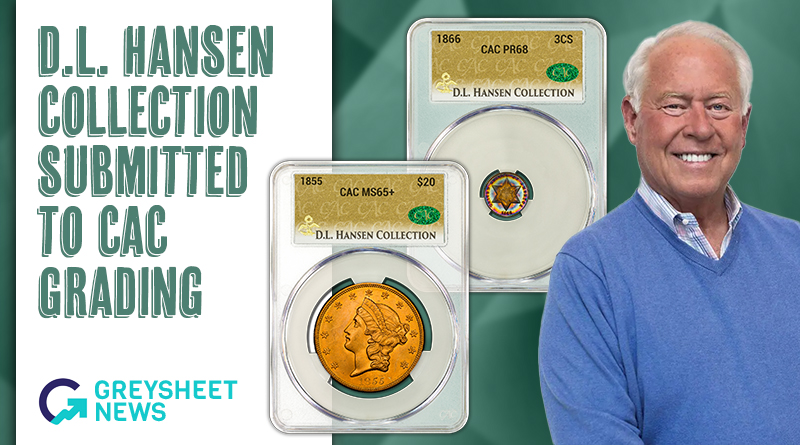
Prominent Collector Dell Loy Hansen Submitting His Historical Collection Of U.S. Coins To CAC Grading
8/8/2024
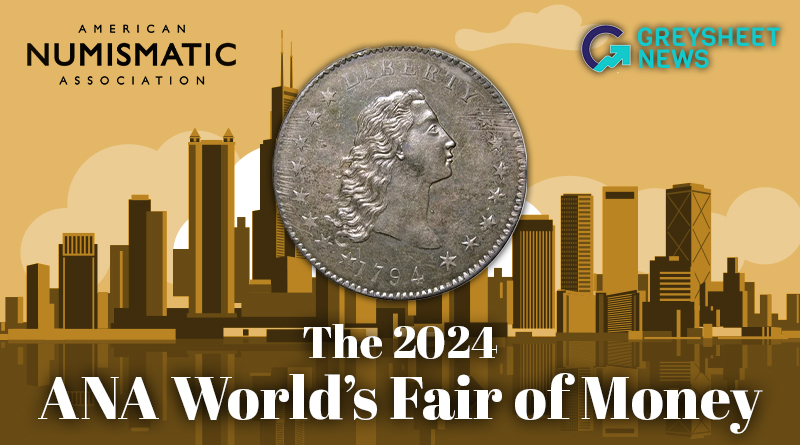
American Numismatic Association's Largest Coin Show, August 6-10 In Chicago
Dazzling rarities, free educational opportunities, family fun and more await at the Donald E. Stephens Convention Center
7/25/2024
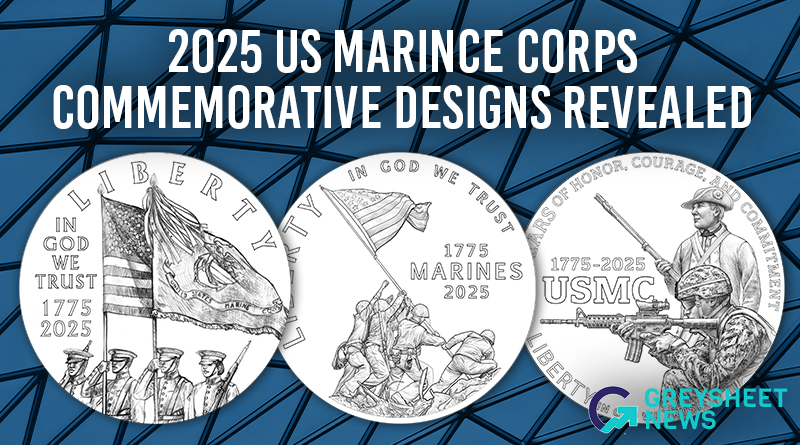
United States Mint Unveils Designs For The 2025 United States Marine Corps 250th Anniversary Commemorative Coin Program
The designs will be featured on a $5 gold coin, a $1 silver coin, and a half dollar clad coin.
7/23/2024
Events
Heritage Auctions: US Coins Tuesday & Wednesday Select Auction
Location: Heritage Auctions
Wednesday, July 1, 2026
Heritage Auctions: World & Ancient Coins Wednesday & Thursday Select Auction
Location: Heritage Auctions
Thursday, July 2, 2026